Alice Brooke
Guest Contributor
Associate Professor in Spanish, Merton College


Disciplinary Brief

Associate Professor in Spanish, Merton College
Love is an I know not what
That comes I know not whence
And slips inside, I know not how
And wounds I know not where
[…]Now I see God; now I don’t,
And I know not where he hides
As he slips inside, I know not how
And wounds I know not where.(Cecilia del Nacimiento, ‘Definition of Love’) [ 1 ]
Whenever I am asked ‘what I do’ (or, in academic circles, ‘what my field is’), I often struggle to answer in a way that is both accurate and understandable. I work in a Faculty of Modern Languages, but my research and teaching do not conform to most people’s immediate definition of a ‘linguist’: I claim no expertise in linguistics (the scientific study of language and its structure), nor do I primarily teach anyone to communicate in an additional language. Most of my time and attention, in both teaching and research, is dedicated to the study of texts; often, but not exclusively, these are literary ones. Neither, however, would I first and foremost describe myself as a ‘literary critic’, a term that within the academy tends to evoke a particular training in textual criticism that has shaped the study of English-language literature over the past century.
Instead, the term that most aptly describes the work to which I dedicate a significant portion of my time is one that is much more readily used in non-English speaking contexts: philology. Historically, philology has tended to be viewed negatively in Anglo-American contexts as a regressive, pedantic, or bathetic concern with the historical development of words, which lacks a more imaginatively expansive vision of how texts shape a culture or contribute to its most pressing or ambitious enquiries. Elsewhere in Europe, however, the discipline of philology retains a status of intellectual prestige. This has its roots in its original role within Renaissance humanism (its first occurrence in English dates from 1522) as a key foundational discipline, whose work to recover little-known texts and to precisely elucidate their mechanics laid important groundwork for broader philosophical and religious debates and ensured that these were conducted with the greatest possible intellectual clarity (Richard Scholar, ‘The New Philologists’, p. 27-28). [ 2 ]
Etymologically, the term found its way into European vernaculars in the sixteenth century from the Greek terms philos (love) and logia (words), denoting its practitioners in the simplest terms as ‘lovers of words’. What might it mean, therefore, in today’s academy, to be not only a philologist, as a lover of words, but a philologist who claims to love and to follow Christ, the Word? Put this way, what does it look like to be a philological philologist? Thankfully, the history of written texts from across Europe and further afield proffers us many examples of fellow travellers who loved both Christ and words. Indeed, we are the inheritors of a rich tradition that understood profoundly, and delighted in, the notion that the divine Word and human words exist in complex, intimate relationship to one another: our human speech a distant reflection, yet a reflection nonetheless, of the divine creative Word, its uses displaying both the possibilities of the human imagination and a means to direct one another in the task of right viewing of the created world and our place within it.
This relationship proved a particularly rich source of inspiration during what is often termed the Spanish ‘Golden Age’, one of Spain’s intellectually and artistically most fruitful periods that occurred during the sixteenth and seventeenth centuries, catalysed both by the heights of its imperial ambitions and its subsequent economic and political decline. Here, a counter-reformation society imbued with religious doctrine and devotion, combined with a preoccupation with forging a new language through which to negotiate rapidly changing political, religious, philosophical, and epistemological landscapes, produced intense and varied ways of grappling with the relationship between Word and word.
One particular expression of this negotiation occurred in the context of the renewal of religious orders that took hold across the Iberian Peninsula during the sixteenth century through the work of Saint Ignatius Loyola (1491–1556), Saint Peter of Alcántara (1499–1562), Saint Teresa of Ávila (1515–1582), and Saint John of the Cross (1542–1591), among others. These reforms included renewed emphasis on the vows of poverty, chastity, and obedience and on the rule of silence, alongside formation in contemplative prayer, which, in the case of Saint Teresa, Saint John, and Saint Peter, emphasised what has come to be known as a ‘mystical’ union with God: an ineffable experience that allows for the apprehension of truths that are normally accessible neither through the senses nor the intellect.
Central to these writers’ approach to prayer was the contemplation of the ‘mysteries’ of God’s action in relation to creation, at the centre of which is love: God, in love, ‘goes out from the depths of the divine nature to create, then to become incarnate, to draw creation back to its divine source’ (Rowan Williams, Teresa of Avila, p.143). [ 3 ] This ‘drawing in’ transforms the soul into the likeness of God, who is love, and from there it goes out, in turn, to love God and others. It is this experience, of participation in the mystery of God’s love, that is at the heart of the substantial corpus of early modern Spanish ‘mystical’ writing. Here, each writer faces the quintessential challenge of the Christian contemplative writer: how to express in words an experience that is simultaneously ineffable, since it transcends the ordinary processes of human cognition and verbal expression, yet also by definition verbal, as centred on union with Christ, the divine logos?
While writers including Saint Teresa and Saint John cultivated manifold ways of expressing the inexpressible, including allegory, metaphor, provisional articulations, and poetic licence, in the following essay I turn my attention to a much lesser-known poet and spiritual writer, Cecilia del Nacimiento (Cecilia of the Nativity, 1570–1646), to explore how her use of natural imagery, specifically her image of the moth, which draws on the writings of her spiritual predecessors, Saint Teresa and Saint John, seeks to bridge this gap between divine union and human language, and points to ways in which human words, despite their shortcomings, can direct her reader along her own path of spiritual formation. In doing so, she presents a valuable model for twenty-first century scholars, across the disciplines, to integrate the intellectual and the spiritual life through a loving observation of the created world filtered through union with the Word.
Born in 1570 in Valladolid, Spain, Cecilia was raised as the youngest of nine children in a devout and highly intellectual middle-class family. In 1589, following several siblings before her, Cecilia entered the discalced Carmelite convent in Valladolid, founded by Saint Teresa as one of the first houses to follow her reforms. There, Cecilia was trained in the Teresian method of contemplative prayer. In 1602-1603, she experienced the state Teresa describes as ‘spiritual marriage’—a total and life-long union with Christ—in the wake of which she composed several spiritual treatises, dozens of poems, and a substantial corpus of correspondence.
In one such poem, ‘Sin figura en la memoria’ (My memory, of images, empty), Cecilia describes the process of kenosis, the emptying and purifying of the self from worldly desires to focus entirely on the contemplation of God. [ 4 ] In her central image, the ascent of the soul towards the holy dwelling place of God, Cecilia combines influences from the spiritual instruction of both Saint John and Saint Teresa: the soul’s upwards progression along a path is reminiscent of John’s Ascent of Mount Carmel (Subida del Monte Carmelo), yet the language of the sacred dwelling place (‘sacra morada’) to which the soul arrives is drawn from Teresa’s Interior Castle (Las moradas del castillo interior). [ 5 ]
In her opening lines, Cecilia illustrates the transformation of the Christian soul through union with God through the metaphor of the moth drawn to the flame:
Memory, of images, empty;
affections, of all desires spent;
quietened, this path I ascend.A modest moth returns to dust,
then, like phoenix in candle’s flame,
all beautiful rises again.Oh, what wondrous exchange is this,
that for the nought that I renounce,
in God, everything have I found! [ 6 ]
Here, Cecilia draws on both Saint John and Saint Teresa to construct her image. Throughout her writings, Saint Teresa uses the moth as a metaphor for the soul as it progresses towards union with Christ. [ 7 ] In the Interior Castle, she describes the metamorphosis of the silkworm that spins its chrysalis and emerges to new life as a moth as akin to the Christian soul that dies to self and is transformed to new life in Christ. In the first stages of the Christian life, just as the summer heat provides the worm’s sustenance through budding leaves, so the Holy Spirit prompts the soul to engage in the spiritual disciplines that form it for spiritual growth, including good books, sermons, and meditations. Nourished by this food, the soul matures until it is ready to build for itself the house in which it is to die, that is, to hide its life in Christ, die to self, and be raised to new Christian life (Interior Castle, V.2). In the later stages of contemplative prayer, described both in her autobiography, Book of her Life (Libro de la vida) and the Interior Castle, as the soul desires a more complete union with Christ, it undergoes a second death, presented through an analogous metaphor of the moth, though one that is less explicitly expounded (Life XVIII (Peers I.110); Interior Castle VI.4-VII.3 (Peers II.286-II.342)): like the photokinetic moth, who is inexorably attracted to a lethal flame, first singes its wings, then is drawn to its death, so the soul who is alive in Christ is drawn ever closer to Him as the fire of His love for her grows, until the soul enters fully into union with Christ, in the state Teresa describes, drawing on St Paul, as the mystical marriage:
Perhaps when St Paul says: ‘He who is joined to God becomes one spirit with Him,’ he is referring to this sovereign Marriage, which presupposes the entrance of his Majesty into the soul by union. And he also says: ‘For me, to live is Christ, and to die is gain’. This, I think, the soul may say here, for it is here that the little [moth] to which we have referred dies, and with the greatest joy, because Christ is now its life. (Interior Castle VII.2; Peers II.336)
In her poem, Cecilia clearly finds inspiration in Teresa’s entomological metaphor, which in turn may well be derived from common medieval iconographical uses of the moth as a Christological image, in which the self-enclosure within the chrysalis stands for the Incarnation, and ultimately Passion, before the emergence to new life at the Resurrection. This image is found throughout medieval and early modern Spain, primarily in the illuminations of Books of Hours, with which Cecilia would likely have been familiar through her mother, an accomplished illuminator. The tradition is exemplified here in an image from Isabella I’s Book of Hours, in which the moth and the chrysalis appear to the left-hand side of a depiction of the Annunciation:
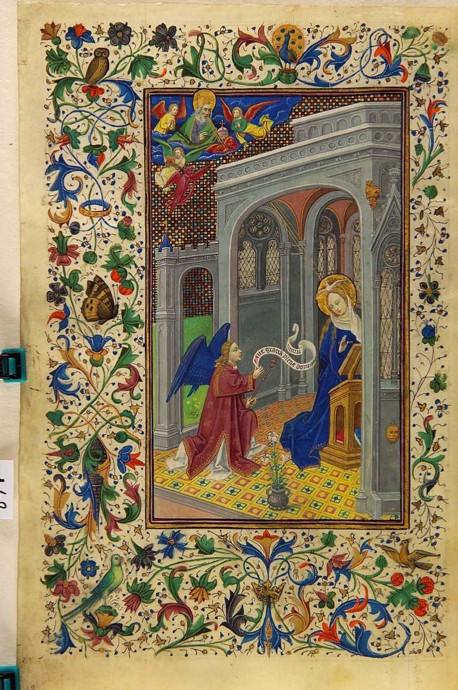
(Moth and chrysalis, Isabella I’s Book of Hours (1450-1499), Biblioteca del Palacio Real de Madrid, folio 181, https://rbdigital.realbiblioteca.es/s/realbiblioteca/item/11497 )
Cecilia’s formulation, however, draws equally on contemporary secular love poetry, especially of the Italianate tradition, in which she had been schooled by her Renaissance humanist mother (her awareness of Italianate poetics is attested by her command of the sonnet form, a relatively recent formal innovation in the Spanish language). Here, poets exploited the ambiguity of the Greek psyche (meaning both soul and butterfly/moth) to conceive of the lover’s soul drawn towards the beloved like the moth drawn to the flame. As an example, Diego Hurtado de Mendoza (1503-1575) writes:
As a simple [moth] I return to the flames
of your beauty, in which I burn;
and I when I feel the pain and change my course
then love forces my return. [ 8 ]
In these poems, a similar comparison is repeated each time: both the moth and the soul are attracted to that which will lead to death (imagined as unrequited love), and in secular poetry the soul often undergoes a kind of spiritual rebirth through the trials of love. Cecilia’s moth, however, drawn to union with Christ, undergoes not some vague spiritual awakening, but rather a true resurrection into life with Him, like the phoenix from the flames.
By comparing the moth not to Christ, but to the human soul made in His likeness, both Cecilia and Saint Teresa extend their metaphor to show how the ‘new creation’ (2 Corinthians 5. 17) promised to those who are in Christ leads to a transformation of the rational functions of the soul as they are conformed to His likeness.
Here, she develops her metaphor of the moth-as-soul according to the Augustinian tripartite division of the faculties of the soul (memory, understanding, will), in which the moth takes on the properties, alternately, of the understanding and the memory. In the early stages of contemplative prayer, as described in the Life, both faculties, like the moth, are restless, flitting from place to place, without finding focus.
It [the understanding] rests nowhere, but goes from one thing to another, like nothing so much as those restless, importunate little moths that fly by night: just so the understanding flies from one extreme to the other. (Life, XVII; Peers, I.103)
As the contemplative progresses in prayer, however, this aimless motion is quieted through union with God. As the fire that attracts the moth may also burn its wings, thwarting its flight, so the fire of God’s love displaces frivolous thoughts and brings the soul to rest:
All the faculties now fail and are suspended in such a way that, as I have said, it is impossible to believe they are active. If the soul has been meditating upon any subject, this vanishes from its memory as if it has never thought of it. If it has been reading, it is unable to concentrate upon what it was reading or to remember it; and the same is true if it has been praying. So it is that this importunate little butterfly—the memory—is now burning its wings and can no longer fly. (Life, XVIII; Peers, I.100)
In Cecilia’s poem, this process is reflected in the verses already cited above: ‘no images in my memory’, ‘nothing captured by affection’. By juxtaposing her description of the soul’s rational faculties to her image of the moth, Cecilia echoes her foremother’s account. Throughout the poem, Cecilia further develops this theme of the transformation of the soul through union with Christ. She speaks of ‘vain imagination’ (‘vana imaginación’, l.16) and ‘disordered affections’ (‘afición desordenada’, l.17) that are purified through the purgation of the soul. Across the verses, she plays with the concept of nothingness (‘nada’). The things of the world are nothing to her (Acts 20:24), since she desires nothing but God. The fulfilment of this desire costs, simultaneously, nothing and everything: everything, since it demands total self-renunciation; nothing, since it is given freely, in exchange only for the things of the world, which are themselves worthless.
Here, Cecilia draws not only on Saint Teresa, but combines her influence with Saint John’s. The influence of the latter is indicated through the image of the ascending path ‘in stillness, I ascend’ (‘subo esta senda, quieto’). The poem’s setting remits the reader to his poem Ascent of Mount Carmel and its prose gloss, in which he depicts the soul, in the guise of a female beloved, leaving her house and ascending a ladder to find her lover who awaits her arrival. In his gloss on the poem, he describes the upwards path towards union with Christ using the same term as Cecilia: ‘esta senda del alto monte de perfección’ (‘this path ascending the high mountain of perfection’, Ascent II.7; Peers p.83). As the verses progress, this influence becomes increasingly visible, specifically through their respective treatments of the transformation of the faculties of the soul, which set out a vision that complements the one we have already seen in Saint Teresa.
In his gloss on the Ascent, Saint John sets out how, in preparation for union with Christ, the faculties of the soul must be transformed and perfected through the three theological virtues: faith, hope, and love. Like Saint Teresa and Cecilia, he describes how each faculty is first emptied, and then is transformed by its related virtue: faith takes the place of understanding, hope the place of memory, and love the place of will:
These three virtues, as we have said, all cause emptiness in the faculties: faith, in the understanding, causes an emptiness and darkness with respect to understanding; hope, in the memory, causes emptiness of all possessions; and charity causes emptiness in the will and detachment from all affection and from rejoicing in all that is not God. (Ascent, II.6; Peers, p.79)
Likewise, in the later verses of Cecilia’s poem, her emptied memory and disordered affections are transformed into faith, hope, and love:
In these most holy mansions, where
the nought and the Everything dwell,
Faith opens her eyes, darkness dispelled.In her fervent resolve does Hope
now cleave so zealous to the Cross;
her hopes, save God, to naught all lost.Her charity is all employed
for God, and thus so finely-wrought
that she binds the All with the naught. [ 9 ]
Thus transformed, she closes her poem returning to the language of death and new life in Christ, which Saint Teresa had associated with her image of the moth. Where Teresa had cited Philippians (‘For me, to live is Christ, and to die is gain’) to describe the soul-moth in its process of death and resurrection (‘This, I think, the soul may say here, for it is here that the little [moth] to which we have referred dies, and with the greatest joy, because Christ is now its life’), Cecilia indexes a similar Pauline sentiment in Romans (‘So you must also consider yourselves dead to sin but alive to God in Christ Jesus’, Romans 6:11), to express the culmination of the soul’s kenosis, alive to God, but dead to the world:
Alive to God, and dead to all,
love is now my death and my life,
and here nothingness is my flight. [ 10 ]
Cecilia’s poem, read alongside its sources in the writings of Saint Teresa and Saint John, has several things to say about Christian love that relate to O’Donovan’s brief.
First, when Cecilia, Saint Teresa, or Saint John speak of the ‘spiritual marriage’, they experience it in what we might call ‘erotic’ terms: as the fulfilment of a desire, a longing of the soul, which they were unafraid to express in sensuous language. While Cecilia evades John’s hermeneutically sealed erotic poetics, her poem nonetheless evokes the sensuality of human sexual love through its appropriation of the moth as an image with its roots in both religious iconography and secular love poetry. This aspect of the poem is emphasised through its evocation of nakedness, the ‘penetration of pure love’, and in its description of divine love as a ‘sweet shadow’, and ‘delightful fruit’ (‘Here the fruit is pleasure sublime, | in the shadow she finds sweet rest: | for God is both love and death’, ll. 52–54 ). [ 11 ] Indeed, the intertwining of the imagery of love and death in the final verses echoes much secular love poetry of the medieval and early modern period, and evokes motifs that would have been immediately recognisable to many contemporary readers as belonging both to the language of religious devotion and to the lexis of human erotic love.
The early modern Carmelites, therefore, would have shared O’Donovan’s scepticism of a rejection of eros within a Christian framework. Indeed, their writings affirm the goodness of human physical love within the context of marriage, in which each spouse takes pleasure in union with the other. True eros, in their understanding, is not a ‘love centred on the self’ (O’Donovan, p.5) but one that is always open to union with the other, and which, in the natural order of things, leads to agape: union with Christ leads to self-sacrificial action, just as marital union precedes a particular demand of self-sacrificial love, whether between the spouses, or to children.
Second, this state of union affects the whole self, including the soul in its rational functions: it operates a change in the will by first transforming the memory and the understanding. Here, it would be easy to misunderstand Cecilia’s poem as a praise of a permanent state of pure contemplation, with no room for the active life, or secular intellectual pursuits. This, however, would be difficult to reconcile either with Cecilia’s own life and her lifelong interests in literary, artistic, and natural philosophical pursuits, or with broader Carmelite teaching. Crucially, when Cecilia, Saint Teresa, and Saint John speak of the ‘emptiness’ of the faculties—of the memory devoid of images and possessions, of ‘detachment from all affection’—they are not speaking of a nihilistic desire for nothingness, or an emptiness akin to Buddhist sunyata, but rather a purification of all that is not God. Indeed, Saint John makes this explicit, when he states (cited above) that we ‘withdraw our affection’ from ‘all things’, ‘in order to set it wholly upon God’ (emphasis mine). Clearly, Saint John’s intention is not that the will have no object, but that its object be solely to love God.
Indeed, for Saint Augustine, Saint John’s source for his model of the soul, the memory, rightly directed, plays a crucial role in the soul’s desire for God. Since, he argues, there is a universal desire for happiness, and that the desire for affective states is only possible if a prior experience of them is stored in the memory, this suggests that there must be some universal prior experience of happiness, which we recall in our desire for its renewal. For Augustine, this points to our origins in a state of happiness in union with God (Confessions, X.21). This use of the memory and of affect, then, to recall our original state, and to acknowledge our desire to return to it, is for both Saint John and Saint Augustine a rightful use, distinct from the ‘disordered affections’ that detract from it. Indeed, later in the Ascent, Saint John extends the goodness of such affective states to encompass all that is ‘the honour and glory of God’:
Now when these faculties, passions and desires are directed by the will toward God, and turned away from all that is not God, then the strength of the soul is kept for God, and thus the soul is able to love God with all its strength. […] These passions, when they are controlled by reason according to the way of God, so that the soul rejoices only in that which is purely the honour and glory of God, and hopes for naught else, neither grieves save for things that concern this, neither fears aught save God alone, it is clear that the strength and ability of the soul are being directed toward God and kept for Him. (Ascent, III.16.2, Peers, 271).
Similarly, for Saint Teresa, this pure focus of the will is not simply a contemplative reciprocation of divine love, but an onwards and giving of that love to neighbour, following Christ’s instruction to ‘love one another: just as I have loved you’ (John 13:34). Indeed, if we follow Teresa’s teachings on spiritual union, she defines the litmus test for spiritual union not (as the popular imagination might have it) in mystical flights of ecstasy, but in active love of God and of neighbour (what O’Donovan terms ‘action’):
This, my daughters, is the aim of prayer: this is the purpose of the Spiritual Marriage, of which are born good works and good works alone. Such works, as I have told you, are the sign of every genuine favour and of everything else that comes from God. (Interior Castle, VII.4; Peers, II.346)
She herself, in her reforming verve, embodied this. From a single-minded desire to honour and glorify God, therefore, a variety of ways of being in the world can spring: whether dedication to cloistered prayer, the composition of poetry and devotional works, or the wholesale renewal of a religious order. Each of these would fulfil O’Donovan’s working definition of love as an ‘affective and directive attention to a good’ (p.3), while reminding us (especially in the first of these examples), that ‘attentive acts, such as listening, learning and wondering [and, we might add, praying] are forms of action’ (p.4). Indeed, the Carmelite vocation to prayer is not simply one of withdrawal from the world, but of withdrawal from its concerns so as to work for its good through continuous prayer.
Finally, Cecilia, Saint Teresa, and Saint John might together help to answer one aspect of O’Donovan’s question as to how the academic might ‘love that own aspect of the world which they know very well, while also focussing their love finally upon God and their neighbours’ (p.7). Specifically, while O’Donovan emphasises the end to which such love is ordered, he pays less attention to the significance of its origins. Rightly, O’Donovan starts by asserting that the Christian academic must ‘receive their work as a vocation’ (p.7), acknowledging that any Christian act of love does not begin with ourselves, but is always already a response to the action of God Himself. This divine action, however, as the contemplatives remind us, does not begin with the individual vocation to a particular discipline, field, or object of study, but much further back in time, with creation itself, in God’s loving action in ‘[going] out from the depths of the divine nature’, and ‘drawing’ us back to Himself (Williams, p.143). Our vocation, therefore, is part of a longer arc, starting with creation itself, continuing with the Incarnation, God’s reaching out to us in order to draw us back to Himself, and from that place of union, a desire, now stemming from a soul ordered entirely to God, to go back into creation, seeing our action as a privileged response to the original creative action of God.
A practical illustration of this mindset, indeed, might be found when returning to Saint Teresa’s meditation on the moth, this time with emphasis on its careful attention to the work of nature in which she finds inspiration. Here, we see clearly that the process of union begins not with our own inclinations or desires, but with God’s loving action towards us, illustrated through His provision of summer heat to ensure the growth of the mulberry tree and with it the silkworm’s sustenance:
When the warm weather comes, and the mulberry-trees begin to show leaf, this seed starts to take life; until it has this sustenance, on which it feeds, it is as dead. […] The silkworm is like the soul which takes life when, through the heat which comes from the Holy Spirit, it begins to utilize the general help which God gives to us all, and to make use of the remedies which He left in His Church. (Interior Castle, V.2; Peers, II.253)
Indeed, as she continues, it is clear that as much as the moth becomes a central spiritual metaphor as a means to overcome the difficulties of expressing the ineffable experience of mystical union, it starts as an attentive (even if second-hand) entomological observation, which itself points to a reflection on divine creative wisdom:
You will have heard of the wonderful way in which silk is made— a way which no one could invent but God. […] If no one had ever seen this, and we were only told about it as a story of past ages, who would believe it? And what arguments could we find to support the belief that a thing as devoid of reason as a worm or a bee could be diligent enough to work so industriously for our advantage, and that in such an enterprise the poor little worm would lose its life? This alone, sisters, even if I tell you no more, is sufficient for a brief meditation, for it will enable you to reflect upon the wonders and the wisdom of our God. What, then, would it be if we knew the properties of everything? It will be a great help to us if we occupy ourselves in thinking of these wonderful things and rejoice in being the brides of so wise and powerful a King. (Interior Castle, V.2; Peers II.253)
Saint Teresa here, herself a woman of little formal education, encourages the nuns to whom she writes to ‘occupy [themselves] in thinking on [the] wonderful things’ of creation, and to reflect on their properties and their workings. From this observation, she encourages them to move to contemplate both their own human shortcomings (they do not, indeed, understand, and nor do we, ‘the properties of everything’) and their place in the redeemed order as brides of Christ.
In this way, the intellectual life can be seen to imitate the contemplative one as grounded in a dynamic of mutual relationship, of being drawn into participation in the divine movement in creation and of responding by rejoicing in the wisdom of the creator. Here, God moves in loving action towards creation by providing its continued sustenance; as participants in creation, we observe his action and are prompted to reflect on His wisdom and wondrous nature; we thus return to God rejoicing in His love for us, and finally go out, sharing that wonder with others, as Saint Teresa does in her writings, as testament to His love.
Significantly, Teresa here does not simply observe the workings of the silkworm and acknowledge intellectually their divine origins, but rather is prompted to the rightly ordered affective response of joy. In this, the contemplation of nature becomes an expression of Augustine’s definition of the happy life, in which the universal desire for happiness is mirrored by a universal desire for truth:
The happy life is joy based on the truth. This is joy grounded in you, O God, who are the truth, ‘my illumination, the salvation of my face, my God’ (Ps. 26: 1; 41: 12). This happy life everyone desires; joy in the truth everyone wants. (Confessions, X. 23) [ 12 ]
This singular focus, on God who is Truth, is reflected in the cognitive development described by Saint Teresa in the soul’s progress towards union: starting as the moth that flits from object to object, never finding a place to rest, its encounter with the flame of God’s love, which will ultimately bring about its death to self, starts by singeing its wings, stilling them from their anxious flitting, preventing it from straying from Him. Likewise, it is her focus on Christ, her repeated coming closer and closer to His love, that transforms the soul from restless searching to quiet serenity, and clear focus. In Augustinian terms, the moth is now freed from being ‘more occupied in other things which make them more wretched than their tenuous consciousness of the truth makes them happy’ (Confessions, X.23).
Here, then, we can flesh out the model for the intellectual life as an expression of Christian love that O’Donovan describes: starting always with God’s own gift of self in creation and the Incarnation, we find ourselves drawn back to Him as we contemplate ‘that one aspect of the world which [we] know very well’ and recognise His workings in it. Seeing creation in this way, rightly ordered as God’s handiwork, ought to prompt us to rejoice: not in creation itself, but in its Creator, with whom we are, in our joy, drawn to closer union, and because, as Saint Augustine sets out, in recognising the true nature of creation, we rejoice in truth itself, who is God. As both he and Saint Teresa remind us, through the grace of God, the restless tendencies of the mind can be quieted, drawing us in love to a singular focus on the truth, as reflected in creation, a truth to which we ‘return again and again’, a truth in which we rejoice.
Augustine of Hippo, Confessions, trans. Henry Chadwick (Oxford: Oxford University Press, 2008)
Díaz Cerón, José María, ed. Cecilia del Nacimiento, O.C.D. Obras completas (Madrid: Editorial de Espiritualidad, 1971)
John of the Cross, Saint, Ascent of Mount Carmel, trans. E. Allison Peers (London; New Work: Burns and Oates: 1983)
McIntosh, Mark, Mystical Theology: The Integrity of Spirituality and Theology (Cambridge: Blackwell, 1998)
Nelstrop, Louise, Christian Mysticism: An Introduction to Contemporary Theoretical Approaches (Farnham: Ashgate, 2009)
Peers, E. Allison, Studies of the Spanish Mystics, 3 vols. (London: SPCK, 1951)
Scholar, Richard, ‘The New Philologists’, in Ita MacCarthy, ed. Renaissance Keywords (Oxford: Legenda, 2013), pp. 19–33
Teresa of Avila, Saint, The Complete Works, trans. E. Allison Peers, 3 vols. (London; New York: Burns and Oates, 2002)
Trueblood, Alan, Actas del Quinto Congreso de la Asociación Internacional de Hispanistas : celebrado en Bordeaux del 2 al 8 de septiembre de 1974 (Bordeaux: Instituto de Estudios Ibéricos e Iberoamericanos, 1977) pp. 829-837
Williams, Rowan, Teresa of Ávila (London: Continuum, 2003)
[ 1 ] Poem 23 in José María Díaz Cerón, ed. Cecilia del Nacimiento, O.C.D. 1570-1646, Obras completas (Madrid: Editorial de Espiritualidad, 1971), p.599. All citations from Cecilia’s poetry are taken from this edition, and translations given are my own.
[ 2 ] We might contrast here the narrow definition given by the Oxford English Dictionary, ‘the branch of knowledge that deals with the historical, linguistic, interpretative, and critical aspects of literature’, with the more expansive one given by its Spanish counterpart, the Diccionario de la Real Academia Española, ‘the study of cultures as manifested in their language and literatures, principally through written texts’ (Ciencia que estudia las culturas tal como se manifiestan en su lengua y en su literatura, principalmente a través de los textos escritos).
[ 3 ] Indeed, the term ‘contemplation’ is one with which they would have more readily identified, the word ‘mystic’ in this context being a modern invention (see Louise Nelstrop Christian Mysticism, p.1; Mark McIntosh, Mystical Theology, p.11).
[ 4 ] Poem 61 in Díaz Cerón.
[ 5 ] References are taken from Saint Teresa of Avila, The Complete Works, trans. E. Allison Peers, 3 vols. (London; New York: Burns and Oates, 2002); Saint John of the Cross, Ascent of Mount Carmel, trans. E. Allison Peers (London; New Work: Burns and Oates: 1983).
[ 6 ] Sin figura en la memoria, | sin prisión en el afecto, | subo esta senda quieto. || En cenizas convertida | la pequeña mariposa, | renace Fénix hermosa. || ¡Oh trueque maravilloso, | que por nada que he dejado | en Dios todo lo he hallado! (ll.1-9)
[ 7 ] Teresa uses the word ‘mariposa’, which can be translated as either ‘moth’ or ‘butterfly’. In the standard twentieth-century English translation, E. Allison Peers renders it both ways, but principally as the latter, but both etymological accuracy and iconographical significance demand the former: the silkworm becomes a moth, whose muted colouration and flat-held wings evoke humility, a key Teresian concept, in contrast to the vivid colouring and proudly erect-held wings of the butterfly. See Studies of the Spanish Mystics, vol. 1, p.127, 145, 173–4.
[ 8 ] ‘Cual simple mariposa buelbo al fuego | De buestra hermosa do me abrasso, | Y quando siento el daño y huyo el passo | Amor me torna allì por fuerça luego’. Cited in Alan Trueblood, ‘La mariposa y la llama: Motivo poético del siglo de oro’, p.835.
[ 9 ] Abre los ojos la Fe | en esta sacra morada | do vive el Todo y la nada || Hace arrimo la Esperanza | en la cruz de tal manera | que sin Dios, en nada espera. || La caridad hace empleo | en Dios, por tan alto modo, | que junta la nada al Todo. (ll.37-45)
[ 10 ] Vivo a Dios y muero a todo; | el amor me es Muerte y vida | y la nada mi salida (l.55–57).
[ 11 ] Dulce sosiego la sombra, | y el fruto sumo deleite, | que es Dios amor y la Muerte (l.52–54).
[ 12 ] Translations taken from Confessions, trans. Henry Chadwick (Oxford: Oxford University Press, 2008).
Download